

Read here
The 74.7% of the population believes that the mental health of Spaniards has worsened in recent years due to economic difficulties, uncertainty about the future, and daily stress.
75% of Spaniards believe that mental health has deteriorated in recent years.
Four out of ten Spaniards (39.3%) rate their current mental health negatively, and nearly 15% have experienced suicidal thoughts or attempted suicide, according to the study The State of Mental Health in Spain, conducted by the Spanish Mental Health Confederation and the Mutua Madrileña Foundation.
The report was conducted in 2022, involving over 2,000 participants, including the general population, those who have or have had mental health issues, and healthcare professionals.
Specifically, the report reveals that 14.5% of the population has had suicidal thoughts or attempted suicide. This is more prevalent among women (17%) than men (11.7%). However, by age group, suicidal ideation or attempts (31.8%) and self-harm (30.7%) occur most frequently among young people aged 18 to 24.
According to Lorenzo Cooklin, General Director of the Mutua Madrileña Foundation, “Suicidal thoughts are most prevalent among younger groups, with 31.8% of 18- to 24-year-olds reporting suicidal ideation or attempts, more than twice the rate of the general population.”
“Undoubtedly, there is an objective indicator that the situation is worsening and becoming increasingly alarming. In 2021, there were 4,003 suicides in Spain, compared to 3,180 in 2011—an increase of nearly 900 per year. We have a rate of 8.4 suicides per 100,000 inhabitants, still 0.7 points below the global average (9.1), but in 2011 it was 6.8,” Cooklin added.
60% of the population feels worried, fearful, depressed, or sad
More than a year after the pandemic ended, nearly 6 out of 10 Spaniards (57%) report feeling worried, fearful, depressed, or sad. “We conclude that we live in a pessimistic society,” Cooklin noted.
According to the report, 74.7% of the Spanish population believes that mental health has worsened in recent years. The three most frequently cited reasons for this decline are economic difficulties (91.4%), uncertainty about the future (89.0%), and daily pressure, demands, and stress (88.8%). These are followed by the COVID-19 pandemic and the perception that society is becoming increasingly individualistic and competitive.
However, as noted by Nel González Zapico, President of the Spanish Mental Health Confederation, despite the issues they face, 11% of the surveyed population has not shared their mental health problems with anyone, and 87.1% have not shared them with their coworkers.
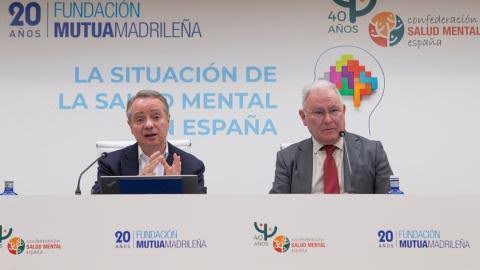
The General Director of the Mutua Madrileña Foundation, Lorenzo Cooklin (left), and the President of the Spanish Mental Health Confederation, Nel González Zapico (right), at the presentation of the report The State of Mental Health in Spain. Courtesy of Mutua Madrileña Foundation.
The report also reveals that 18.9% of the population over the age of 18 consumes psychotropic drugs, with 73% of them taking these medications daily. The most commonly used are anxiolytics (61.9%) and antidepressants (47.2%). General practitioners are the most frequent prescribers (55.1%), followed by psychiatrists (35.2%).
One in five individuals diagnosed with a mental health issue has been admitted to a psychiatric ward. Among them, 60.1% report being involuntarily hospitalized; 40.3% state they received little or no clear, sufficient, and understandable information about their condition; 46.3% report receiving insufficient information about the side effects of their medication; and 48.1% indicate that they were given little or no information about all available alternative treatments.
Profile of a person with poor mental health
A portion of the report assesses the profile and situation of individuals with personal experience of mental health issues (referred to as PEPs) and compares them to the general population.
This group accounts for nearly one in four Spaniards (22.8%) of the total sample, including individuals who have been formally diagnosed as well as those who self-assessed their mental health as poor or very poor in the survey.
“Mental health is an issue that affects everyone. Such a problem can arise at any point in our lives,” warned González Zapico. In any case, diagnoses of mental health problems typically occur during youth. Specifically, the average age of onset for those affected is 26 years old.
Family problems and relationships (36.3%) and self-imposed demands in professional or academic settings (32.4%) are the two most commonly cited triggers for the onset of mental health issues.
In terms of therapies, the study reveals that 57.1% of treatments involve prescribed medications, followed by psychotherapy (47.6%) and participation in social support programs (27.4%).
Among individuals diagnosed with a mental health problem, more than half (58.5%) have experienced social rejection at some point in their lives due to their condition. Additionally, 55% have experienced discrimination, with the workplace being the most common setting for such incidents.