
Read here
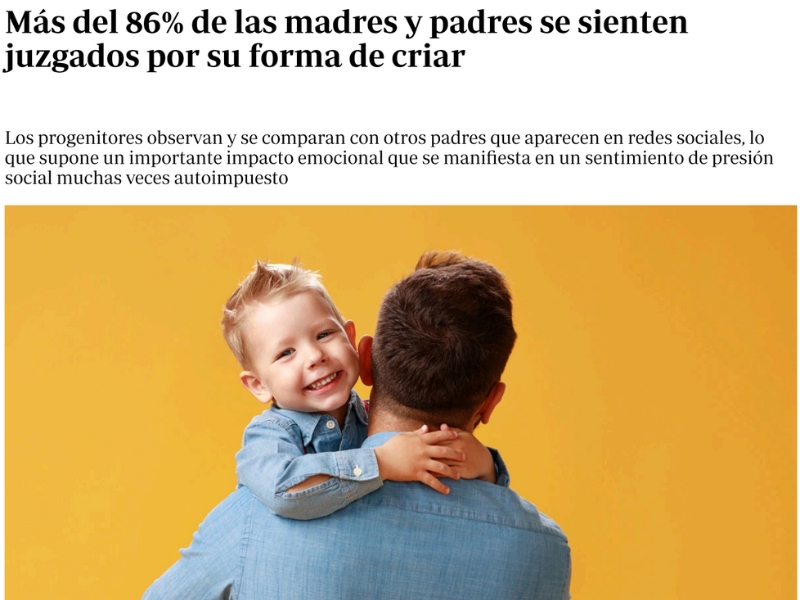
Parents observe and compare themselves with other parents on social media, leading to significant emotional impact often manifested as self-imposed social pressure.
Parents feel pressured by everything they see on platforms like Instagram, YouTube, or TikTok regarding how they care for their children. This is one of the findings of the study “Contemporary Parenting and the Use of Social Media: Tensions and Emotions,” presented at the IV National Congress of Pediatric Nursing Associations.
Among the main conclusions of the study, conducted by Biomecanics with parents of children aged 6 months to 3 years, is the significant impact of the digital environment on their emotional state. The study found that 86.5% of parents “feel judged for their parenting style,” and three out of four report “feeling lonelier than before in their parenting experience,” even though social media allows them to be more connected and better informed.
While the abundance of accessible information is valued positively, it is seen as a double-edged sword. One in five parents stated they “struggle with the constant access to information,” leading to challenges such as increased mental load due to continuous updates or difficulties fully enjoying parenthood.
The high volume of information accessible to parents, while positively valued, is seen as a double-edged sword in its influence on parenting decisions. In fact, 1 in 5 parents states that they “struggle with the constant access to information,” a challenge that leads to consequences such as increased mental load due to constant updates or difficulties fully enjoying the experience of raising their children.
The study reveals significant conclusions about how parenting has evolved in parallel with our relationship to access to information. Parents have found consulting online sources and social media to be a highly valuable tool for accessing information and perspectives from other mothers and fathers. However, this has also heightened their self-demand and the pressure to always make perfect choices. This is an unintended effect linked to new parenting models, and it is advisable for mothers and fathers to learn to put things into perspective,” explains Marta Delgado, CEO of the research consultancy Twiga and sociologist responsible for the study commissioned by Biomecanics.
One of the key points highlighted in the report is the conviction that there has been an evolution in parenting models over the past decade, in which access to massive amounts of information has had a major impact by providing parents with more tools, “making them feel more prepared” and able to anticipate problems. At the same time, parents believe that, while “there is now more scientific evidence about parenting models,” “making decisions has become complicated due to the existence of contradictory trends.” For more than 82% of respondents, raising children today is considered more “challenging,” as “it is not clear what is best,” in contrast to the past, where “there were simpler rules and fixed parameters.”
Despite the increasingly significant role of digital information, traditional advisors remain the primary resource for almost all parents. Pediatricians (96.4%), mothers (94.0%), childcare centers (94.1%), and friends and family with children are the most influential advisors. However, in the current context of uncertainty and continuous comparison of information, other sources, such as parenting books and points of sale for children’s products, are becoming increasingly important. More than 69% of parents consider the internet and social media to be relevant sources of information about parenting, with 6 out of 10 consulting these resources weekly.
The publication of the study “Contemporary Parenting and the Use of Social Media: Tensions and Emotions” also confirms the role of instinct as a tool for making decisions tailored to the reality of each child, thanks to the irreplaceable sensitivity of their parents. This view is reflected in some of the study’s conclusions, showing that for 96.8% of parents, “information provides guidance, but the final decision lies with the parents, who know their children.” In this regard, parents consider that, in moments of doubt, instinct carries 60% of the weight in decision-making compared to 40% for information.
“Continuously comparing and updating information and opinions adds extra mental strain to the parenting of our children. There is no form of parenting more respectful to our children than one that arises from our instinct and our mental well-being,” says Joaquín García, CEO of Biomecanics.